

What Women in Perimenopause Actually Ask About CBD
A lot of what gets marketed to this life stage counts on you not asking the next question. We'd rather answer it, including the parts where the answer is no.
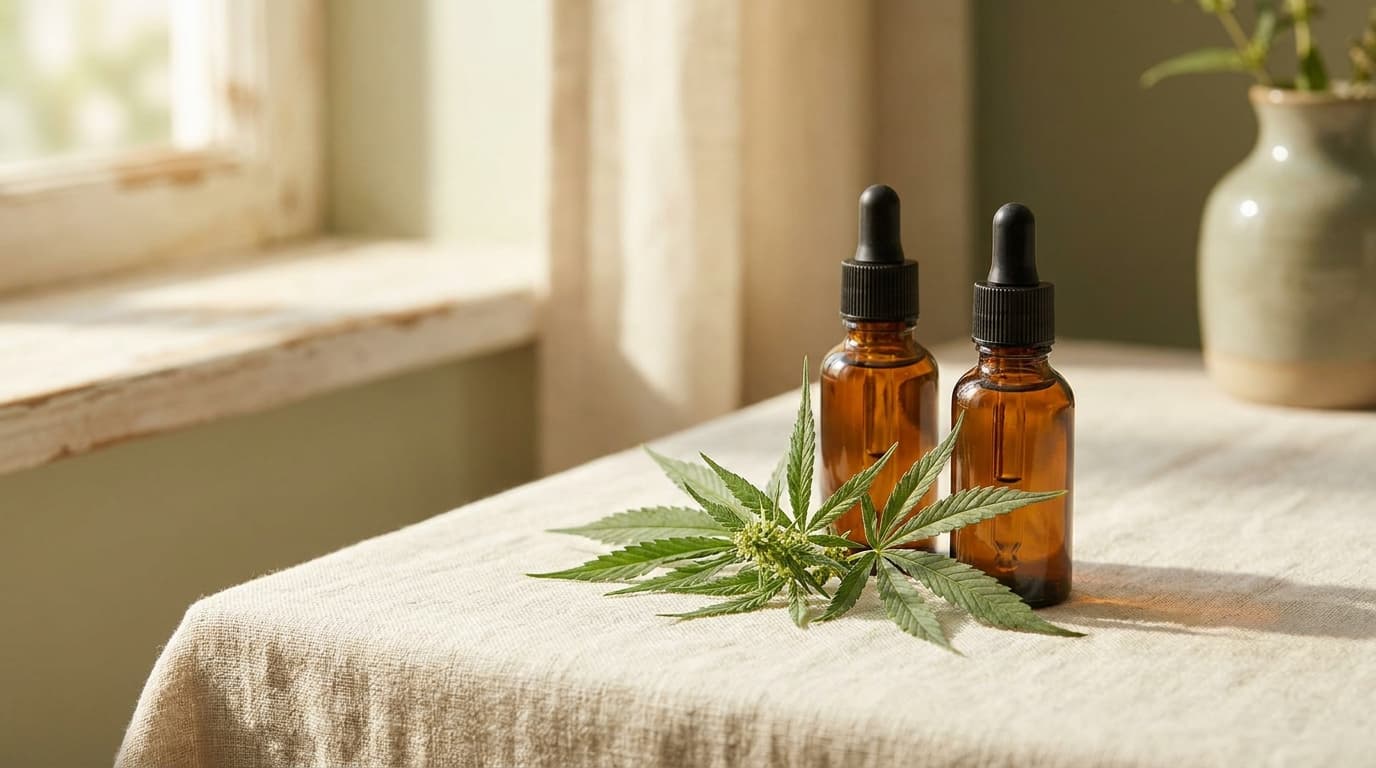
The short version
CBD does not have an established effect on hormones. No published human research shows it changes estrogen, progesterone, FSH, or anything else perimenopause moves around. We're not going to soften that into “may help balance” language, because the honest answer is that we don't know, and “we don't know” is not the same thing as “probably.”
CBD is not a treatment for perimenopause, hot flashes, night sweats, or anything else on the list. Real treatments with clinical trial evidence behind them exist, and they're worth a conversation with your doctor, not a bottle from a wellness aisle standing in for it.
If you still want to try CBD, here's how to do it without wasting money or a drug test: buy the right spectrum for your situation, dose conservatively, check the batch COA, and ask a pharmacist about anything else you take, HRT included, before you start.
What perimenopause actually is
Perimenopause is the transition leading up to menopause, driven by the ovaries' hormone production becoming erratic rather than shutting off on a schedule. The clearest sign is a change in your menstrual cycle (length, flow, or both) as cycles start varying by a week or more from what was normal for you, per The Menopause Society's clinical definition. It typically begins in your 40s, though it can start in your late 30s, and it commonly runs somewhere in the range of four to eight years, with some sources citing a wider two-to-ten-year span. It ends, by definition, twelve months after your final period — that point is what's actually called menopause. In the United States the average age for that final period is around 51.
None of that is a fixed schedule. Two women can be the same age and years apart in where they actually are in this transition, which is itself a reason to be skeptical of any single bottle marketed as the answer to it.
Does CBD affect your hormones?
Here is the honest gap, spelled out rather than glossed over. The endocannabinoid system does help regulate the HPA axis, the pathway that governs cortisol, and researchers have studied cannabinoids and reproductive hormone regulation in animal models. That is a real line of research, not nothing. But a mechanism paper and a clinical trial in perimenopausal women are two different things, and the second one doesn't exist yet. No published human study has shown that CBD changes estrogen, progesterone, or FSH in people going through this transition.
The NIH's own consumer summary of cannabis and cannabinoid research doesn't mention hormones at all. What it does list as known safety signals are liver injury, male reproductive harm in animal studies, and drug interactions — a different list than “hormone balance,” and one worth reading on its own terms. If something marketed to this exact life stage tells you it balances your hormones, ask which study they're citing. If they can't name one, you have your answer.
Is CBD a treatment for perimenopause symptoms?
No, and we're not going to write around that with softer language. The only FDA-approved CBD medicine is Epidiolex, approved for seizures associated with Lennox-Gastaut syndrome, Dravet syndrome, and tuberous sclerosis complex — nothing to do with menopause. Our products, like any CBD product without an FDA drug approval, are not intended to diagnose, treat, cure, or prevent perimenopause or any symptom associated with it.
That doesn't mean nothing works. The Menopause Society's own 2022 position statement calls hormone therapy the most effective treatment available for hot flashes and night sweats, with trial data behind it showing a substantial drop in how often they happen. For people who can't or don't want hormone therapy, the FDA approved a non-hormonal option, fezolinetant (Veozah), in 2023 specifically for moderate-to-severe hot flashes. Medical trials and approvals in this area are generally framed around “menopause” as the umbrella term that includes the transition you're in, which is worth knowing so you're not searching for a drug name that was never going to exist. Neither of those treatments is a CBD conversation. Both are worth having with a doctor, and neither is something we sell — we make CBD oil, not hormone therapy, and we're not going to imply our bottle competes with either.
Full spectrum or THC-free, and why it matters here
This is a place we can be genuinely useful without any hand-waving. Full-spectrum CBD can legally contain up to 0.3% THC under the federal hemp definition, and trace THC accumulates with daily use — enough that it has produced real positive drug tests in people taking a correctly labeled, legal product every day. If you work somewhere that tests (healthcare, education, and government employers are exactly the kind of workplaces that still run pre-employment and random screens, and plenty of others do too), that trace amount is not a rounding error.
Broad spectrum (THC-free) removes the THC and keeps the rest of what the plant makes. It's the one to buy if a positive test would cost you something, and the batch COA is what actually proves the THC is gone — not the label copy. If you're not tested and don't mind trace THC, full spectrum is an equally legal choice; at that point it's a preference, not a safety decision. The exact federal cutoffs, detection windows, and DOT rules for anyone in a safety-sensitive role are laid out in full on our drug-testing page, linked below, rather than repeated here.
How much do people take, and how do you judge it over time?
Most people start at 10-25 mg once a day, held under the tongue, and adjust in 5-10 mg steps from there — our full dosage guide walks through the mg-per-drop math for each bottle size. We're not going to tell you what result to expect, which means “working” has to be a standard you set for yourself rather than one we hand you.
A plain way to do that: pick one dose and one time of day, hold it there for three to four weeks, and keep a one-line log: whether you actually took it, any side effects (drowsiness, dry mouth, and mild GI upset are the common ones), and how you're feeling in general. At the end of a month you'll have your own data on your own routine, which is a more honest basis for reordering than waiting on an outcome we're not promising.
Will it interact with hormone therapy or your other medications?
Possibly, and this is a question for a pharmacist, not a product page. CBD is broken down by, and also blocks, several of the same liver enzymes (CYP3A4 and CYP2C19 among them) that process a long list of common prescriptions. There is a published case report of CBD raising a warfarin patient's INR enough to require a dose adjustment, and the FDA-approved prescribing label for Epidiolex, the one CBD medicine with a full label, documents measured interactions with drugs including clobazam, valproate, and everolimus at pharmaceutical doses.
We have not found a study looking specifically at CBD taken alongside hormone therapy. That gap is exactly why the honest move is to ask rather than assume it's fine because both are “natural.” Bring your full medication list, HRT included, to a pharmacist before adding a daily CBD bottle to it. We wrote a full breakdown of what's actually known about CBD and specific drug classes at CBD and medication interactions, and it's worth reading before you read the rest of this page.
How do you read a COA, and why does it matter more here?
A certificate of analysis (COA) is a third-party lab's report on one specific batch: a cannabinoid panel confirming how much CBD and THC the bottle actually contains, and a contaminant panel checking for heavy metals, pesticides, residual solvents, and microbials.
It matters because labels are frequently wrong. A 2024 analysis of 202 retail CBD products (tinctures, gummies, vapes, and topicals) found that 74% deviated from their labeled potency by at least 10%, and turned up heavy metals, pesticide residue, or solvent residue in a meaningful share of the samples tested. If you're taking something daily for months at a stretch, that is not a detail worth skipping. Match the batch number printed on your bottle to the COA for that batch, not a generic PDF linked from a homepage, and read our full walkthrough if you've never looked at one before.
What does it actually cost to try this properly?
Buy the smallest bottle in whichever line fits your situation and plan to finish it before deciding anything. At a normal daily serving, that's roughly four to six weeks — long enough to know whether you like the taste, whether it sits fine with your stomach, and whether you're actually remembering to take it, which matters more than the per-milligram discount on a bigger bottle. Current pricing for every size is below.
What we'd tell a friend
- Tested at work — healthcare, education, government, or anywhere else? Broad spectrum, and get the batch COA before you rely on it.
- On any daily medication, especially HRT, a blood thinner, an antidepressant, or thyroid hormone? Talk to a pharmacist before you start, not after something feels off.
- Deciding if it's “working”? Set your own standard and give it a real month — we're not going to hand you an outcome to look for.
- Symptoms disrupting your sleep, mood, or daily life? That's worth a doctor's appointment, not a longer wait to see if a supplement helps. Hormone therapy and non-hormonal options like fezolinetant both have real trial data behind them.
- Anyone, us included, claiming a bottle balances your hormones or treats perimenopause? That's the line where marketing outran the evidence.
FAQ
Does CBD affect hormones?
Not as far as any published human research has established, and we're not going to hedge that toward yes. The endocannabinoid system helps regulate the HPA axis (the pathway behind cortisol), and animal studies have looked at cannabinoids and reproductive hormone regulation more broadly, so it isn't a strange question to ask. But a plausible mechanism in a rat study is not the same as a demonstrated effect in a perimenopausal woman, and no clinical trial has shown that CBD changes estrogen, progesterone, or FSH in people going through this transition. If a product claims to 'balance your hormones,' ask what study backs it. We can't name one, so we don't make the claim.
Is CBD a treatment for perimenopause, hot flashes, or night sweats?
No. The only FDA-approved CBD medicine is Epidiolex, approved for seizures associated with Lennox-Gastaut syndrome, Dravet syndrome, and tuberous sclerosis complex, and nothing related to menopause. No CBD product, including ours, is approved or intended to diagnose, treat, cure, or prevent perimenopause or any symptom on its list. Real treatments with clinical trial evidence behind them do exist for hot flashes and night sweats, and that conversation belongs with your doctor.
Should I buy full spectrum or THC-free (broad spectrum)?
If a positive drug test would cost you a job, a license, or a clearance, buy broad spectrum. Full-spectrum CBD can legally contain up to 0.3% THC, trace amounts accumulate with daily use, and it has caused real positive tests in people taking a correctly labeled product every day. Healthcare employers, school districts, and government agencies are exactly the kind of workplaces that still run pre-employment and random screens. Broad spectrum has the THC removed, with a batch COA to prove it. If you're not tested, it's a preference, not a health decision.
How much CBD do people take, and how do I know if it's working?
Most people start at 10-25 mg once a day and adjust in small steps from there. See our full dosage guide for the mg-per-drop math. We're not going to promise a result, so 'working' has to be a standard you set. Hold one dose and one time of day for three to four weeks, and note whether you took it, any side effects, and how you're feeling in general. At the end you'll have your own answer on whether the bottle is worth reordering.
Will CBD interact with hormone therapy or my other medications?
Possibly, and it's a pharmacist question, not a website question. CBD is processed by, and can block, several of the same liver enzymes (CYP3A4 and CYP2C19 among them) that metabolize a long list of common prescriptions. There's a published case report of CBD raising a warfarin patient's INR enough to require a dose change. We have not found a study looking specifically at CBD alongside hormone therapy, which is exactly why the honest answer is to ask first. Read our full breakdown of CBD and medication interactions before you start.
How do I read a CBD certificate of analysis (COA), and why does it matter?
A COA is a third-party lab's report on one specific batch: a cannabinoid panel confirming how much CBD and THC it actually contains, and a contaminant panel checking for heavy metals, pesticides, residual solvents, and microbials. It matters because labels are often wrong: a 2024 analysis of 202 retail CBD products found 74% deviated from their labeled potency by at least 10%, with heavy metals, pesticide residue, or solvent residue turning up in a meaningful share of samples. Match the batch number on your bottle to the COA for that batch, not a generic PDF on a homepage.
What does it actually cost to try CBD properly?
Buy the smallest bottle in whichever line fits your situation and plan to finish it before deciding anything. At a normal daily serving that's roughly four to six weeks, long enough to judge taste, digestion, and whether you're actually remembering to take it, which matters more than a bigger bottle's per-milligram discount.
This article is for educational purposes only and is not medical advice. Perimenopause is a medical transition with real individual variation; talk with your doctor about diagnosis and about treatments with clinical evidence behind them, including hormone therapy and non-hormonal prescription options. botanCBD products are not intended to diagnose, treat, cure, or prevent any disease, including perimenopause or any of its symptoms. Talk with your healthcare provider or pharmacist before starting any new supplement, especially if you take prescription medications, including hormone therapy.
Keep going
CBD and Your Medications
CBD uses the same liver enzyme grapefruit blocks. If a label warns off grapefruit, ask a pharmacist.
Read more →CBD Body Care Across Your Cycle
Where a topical and an oral routine fit across the month, and what the evidence does not support.
Read more →How to Read a CBD COA
Batch numbers, ND vs <0.3% THC, and what a contaminant panel is actually for.
Read more →
