

The Carrier Matters — MCT Oil and Your Skin
Most of what's in a dropper bottle of CBD oil isn't CBD. It's the carrier oil doing the carrying — and that's the part that actually touches your skin.
The short version
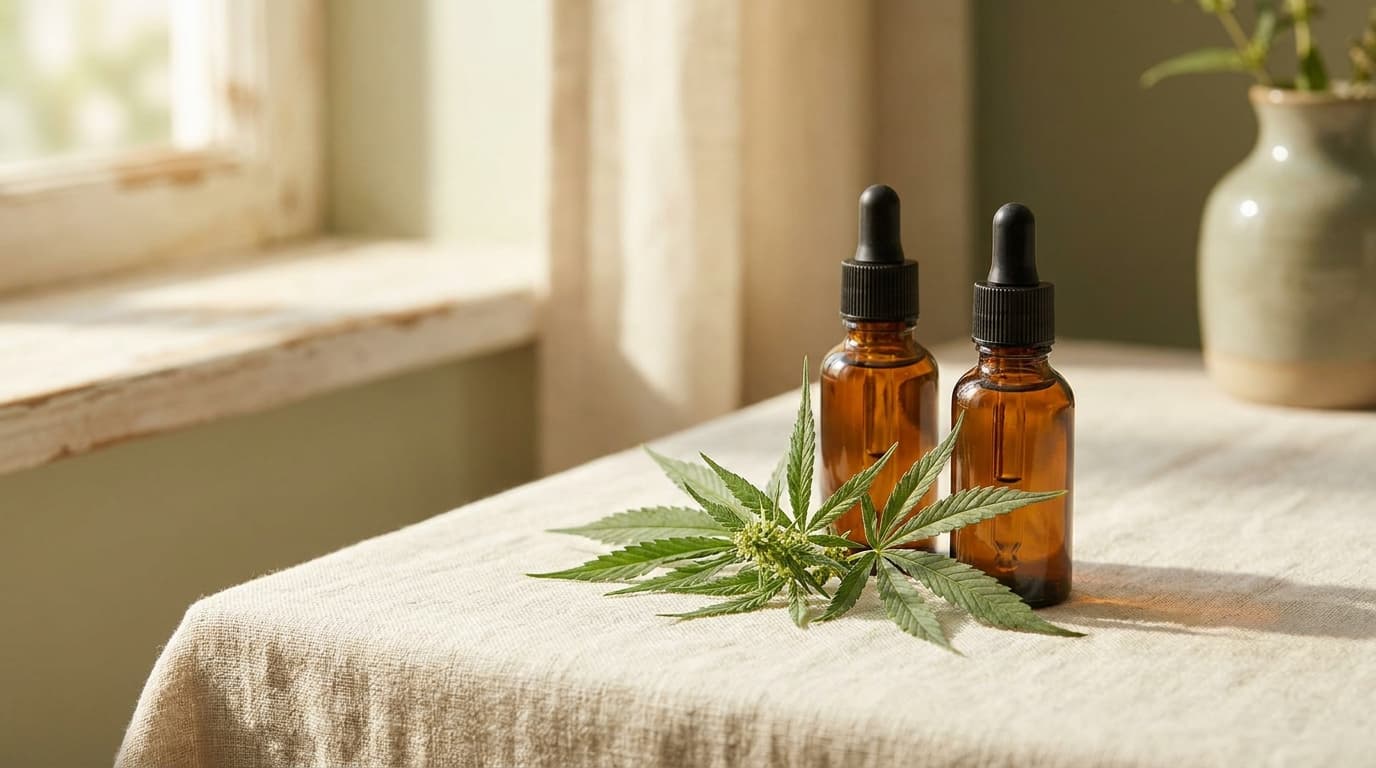
Most of the bottle, by volume, isn't CBD. Hemp extract is a thick, concentrated resin — nobody could dose that from a dropper. It gets thinned into a carrier oil so a bottle can measure out small, consistent servings. botanCBD's carrier is organic MCT: fractionated coconut oil.
MCT isn't a CBD-industry invention. Under its formal name, Caprylic/Capric Triglyceride, it's a mainstream cosmetic ingredient that shows up in thousands of ordinary lotions, serums and facial oils that have never touched a hemp plant.
Some people put the oral drops on their skin anyway. That's fine, and the oil part of that experience is genuinely unremarkable. What isn't the same: the drops are formulated and tested to be swallowed. The product actually built for skin is the Arnica Salve Stick.
What's actually in the dropper
A dropper bottle of CBD oil has, at minimum, two ingredients: a hemp extract and a carrier oil. The extract is where the CBD lives, and on its own it's a thick, resinous concentrate — not something anyone would want under their tongue undiluted, and not something a dropper could measure in small, repeatable amounts. So every tincture on the market, ours included, dilutes that extract into a plain oil. One full dropper works out to roughly 1 mL, about a gram of oil. The cannabinoid content in that gram is measured in milligrams. The rest of it — by weight, the large majority — is carrier oil.
Cannabinoids are fat-soluble, not water-soluble, which is the reason every brand in this category reaches for an oil base instead of a water base in the first place — a plain fact of chemistry, not a claim about what happens once you take it. The choice that actually varies from brand to brand is which oil. The four most common carrier oils in this category are MCT (fractionated coconut oil), hemp seed oil, olive oil, and grapeseed oil. botanCBD's full-spectrum and broad-spectrum lines both use the same one: organic MCT.
Why MCT, and what “fractionated” means
MCT stands for medium-chain triglyceride. Fractionated coconut oil is the same substance under a more familiar name, and Caprylic/Capric Triglyceride is its formal cosmetic-ingredient name — the one on an actual ingredient list. All three describe the same process: whole coconut oil is hydrolyzed to free its fatty acids, those acids are separated by fractional distillation, and only the medium-length ones — caprylic acid (8 carbons) and capric acid (10 carbons) — are kept and re-esterified back onto a glycerin backbone. Everything longer is fractionated out.
That “everything longer” is most of what makes whole coconut oil behave the way it does. Whole coconut oil is roughly half lauric acid, a saturated fat with a long enough chain that it's solid at room temperature — coconut oil famously turns from a white solid to a clear liquid around 76°F (24°C), which is exactly the kind of unpredictable behavior nobody wants in a dropper bottle that might sit in a cold delivery truck one week and a warm bathroom the next. Strip out the lauric acid, along with the myristic and palmitic acid that come with it, and what's left — caprylic and capric acid — stays liquid and clear across a much wider temperature range.
It also barely oxidizes. The Cosmetic Ingredient Review (CIR) — an industry-funded but independent scientific panel that has assessed cosmetic ingredient safety since 1976, with FDA and consumer-group involvement — noted in its 2018 safety review of Caprylic/Capric Triglyceride that the ingredient has a “relatively low iodine number,” a standard chemistry measurement, which “indicates very little unsaturated material present.” In plain terms: it has almost no carbon-carbon double bonds, and double bonds are what atmospheric oxygen actually attacks when an oil turns rancid. Compare that to the two plant oils most often proposed as CBD carrier alternatives. Hemp seed oil runs about 53 to 55% linoleic acid plus roughly 18% alpha-linolenic acid — both polyunsaturated, both carrying multiple double bonds. Grapeseed oil is similar, at roughly 65 to 69% linoleic acid. Both are good oils for plenty of purposes, and both are considerably more chemically reactive than MCT, which is a real, unglamorous reason to pick the one that's hardest to spoil for a product meant to sit on a shelf for a year or more.
What MCT actually does on skin
None of this is CBD-specific, and it isn't supposed to be — MCT's job in a cosmetic formula has nothing to do with cannabinoids. It's a skin-conditioning agent, full stop, and a well-documented one. CIR's 2018 review found Caprylic/Capric Triglyceride was the single most-used ingredient in its entire 51-ingredient triglyceride category: reported in about 6,000 cosmetic formulations as of 2017 industry data, up from 763 formulations in 2003. It's used at concentrations up to 95.6% in leave-on face and neck products — meaning some products on the market are, for practical purposes, mostly this one oil — up to 83.3% in eye-area products, and up to 52% in products formulated for babies. In human patch testing submitted to CIR, a facial oil formulated at 95.51% Caprylic/Capric Triglyceride produced no irritation in a 24-hour occlusive patch test and no detectable photocontact-sensitizing reaction.
That's the honest, unglamorous description of what this oil does on skin, and cosmetic language is the right language for it: it conditions, it softens, it moisturizes, and — because of that light medium-chain structure — it tends to absorb quickly, without the heavier or greasier residue longer-chain oils can leave behind. That is a description of the carrier oil. It is not a description of what CBD does. This site doesn't make that claim, on skin or anywhere else, and nothing in CIR's review has anything to do with hemp.
Is it actually non-comedogenic? The honest answer
You'll see fractionated coconut oil listed on beauty sites with a precise-looking “comedogenic rating” of 2 out of 5. It's worth knowing where that kind of number comes from. The 0-to-5 comedogenicity scale traces back to the rabbit-ear assay, a methodology built in the 1970s and 80s — most notably James Fulton's 1984 paper in the Journal of the American Academy of Dermatology — that applies a substance to a rabbit's ear for two weeks and counts the follicular plugging that results. It's a fast screening tool, and it's also a different biological system from human facial skin. A 2006 re-evaluation of the concept in the same journal, by dermatologists Zoe Draelos and James DiNardo, cautioned against treating rabbit-ear results as a reliable stand-in for what a product will do on an actual human face. There is no single, current, universally agreed numeric rating for every cosmetic oil, however confidently those charts get reposted.
What does exist, and what's worth being straight about, is a 2019 rabbit-ear study, published in the International Journal of Contemporary Medical Research, that tested virgin coconut oil, mill-pressed coconut oil, and a major commercial coconut oil brand side by side with mineral oil. All of them produced statistically indistinguishable comedone formation. Whole coconut oil, in other words, has a real reputation problem, backed by real — if imperfect — data. But that study tested whole coconut oil, still carrying its full lauric acid content. Fractionation is specifically the process that removes lauric, myristic and palmitic acid, the fraction most implicated in that reputation. We did not find a dedicated modern human comedogenicity trial run on the fractionated form by itself. What we can point to instead is the use pattern: an ingredient that clogged pores at scale is not the one formulators and regulators keep approving at higher concentrations for eye-area and baby-skin products, year after year. That's a reasonable inference, not a clinical guarantee — and if you already know your own skin reacts to heavier oils, that's worth listening to over any chart, ours included.
How the other carrier oils compare
Here's the same comparison in one place — what each carrier actually is, chemically, and what that tends to mean once it's on a shelf or on skin.
| Carrier oil | Main fatty acids | Shelf stability | On skin |
|---|---|---|---|
| MCT / fractionated coconut oil | Caprylic (C8) & capric (C10) acid — fully saturated | Very high — low iodine number, minimal unsaturation to oxidize | Light, fast-absorbing, colorless and odorless; used up to 95.6% in leave-on cosmetics (CIR, 2018) |
| Hemp seed oil | ~53–55% linoleic acid, ~18% alpha-linolenic acid (polyunsaturated) | Lower — polyunsaturated fats oxidize faster | Light, marketed as a “dry oil”, but naturally green-tinted with a grassy scent |
| Olive oil | ~70–80% oleic acid (monounsaturated) | Moderate | Heavier and more occlusive; a 2013 controlled human study found twice-daily topical use measurably weakened skin-barrier integrity and caused mild redness versus sunflower oil |
| Grapeseed oil | ~65–69% linoleic acid (polyunsaturated) | Lower — comparable oxidation exposure to hemp seed oil | Light, fast-absorbing “dry oil” feel, similar to MCT |
Notice what's not on this list: a claim that any of these oils changes what CBD does once it's absorbed. That's a different question, and not one this article is answering. This one is about the oil itself — the large majority of the bottle that nobody usually asks about.
The honest trade-off: drops vs. the salve stick
People do put the oral drops on their skin. We hear about it, and we're not going to pretend otherwise. When that happens, what's actually touching skin is mostly MCT oil, plus a small amount of hemp extract — and per everything above, that's an unremarkable thing to put on skin. It's the same category of oil sitting in a lot of the facial-oil aisle.
Here's the part worth being straight about instead. The oil drops are formulated, dosed and quality-tested as something you take by mouth: taste, sublingual serving accuracy, and the cannabinoid milligrams per dropper on the batch COA. They are not formulated, packaged or tested as a topical product — there's no dedicated cosmetic stability or skin-patch-testing program behind the finished tincture, and a glass dropper bottle isn't built for repeated hand contact the way a stick or a jar is.
The product actually built for skin is the 750mg Arnica Infused CBD Salve Stick — a solid stick, not a liquid, made to be applied directly and meant for exactly that use. We don't have a published full ingredient breakdown of its base to compare here, and we're not going to guess at one — that would be exactly the kind of thing this article is arguing against. What we can say plainly: if skin is genuinely the goal, that's the product built for the job. If you're using the oil drops on your skin because that's the bottle already open on your nightstand, you're not doing anything strange. You're using a light cosmetic oil. Just know which botanCBD product was actually engineered for which use.
FAQ
What is MCT oil?
MCT stands for medium-chain triglyceride. It's made by hydrolyzing coconut oil and separating out the medium-length fatty acids — caprylic (C8) and capric (C10) acid — by fractional distillation, then re-esterifying them onto glycerin. Fractionated coconut oil and Caprylic/Capric Triglyceride are the same ingredient under different names; the second is what shows up on a formal cosmetic ingredient list.
Is fractionated coconut oil the same thing as MCT oil?
Yes. MCT oil is the name used in supplement and food contexts, fractionated coconut oil is the name used in skincare and aromatherapy, and Caprylic/Capric Triglyceride is the formal cosmetic (INCI) name. All three refer to the same medium-chain triglyceride blend, made the same way.
Does MCT oil clog pores?
The honest answer is that we didn't find a dedicated modern comedogenicity study on the fractionated form by itself. What does exist: whole coconut oil has real, peer-reviewed evidence of clogging pores in a rabbit-ear assay, but fractionation specifically removes the longer-chain fatty acids most associated with that reputation. Separately, U.S. cosmetic-safety reviewers found no irritation in human patch testing, and formulators keep approving it at higher concentrations for eye-area and baby-skin products. That's reassuring. It isn't a guarantee for every individual's skin.
Can I put CBD oil drops directly on my skin?
People do. The carrier oil itself — organic MCT — is an unremarkable, widely used cosmetic-grade emollient with no particular reason to avoid it on skin. What's worth knowing is that the drops are formulated and tested as something you swallow, not a topical product, so they haven't gone through the fit-for-purpose testing a dedicated skin product would. If you want the product actually built for skin, that's the Arnica Salve Stick.
Why doesn't botanCBD use hemp seed oil as the carrier instead?
Mostly shelf stability and taste. Hemp seed oil is rich in polyunsaturated fatty acids, which oxidize considerably faster than MCT's fully saturated medium-chain fats — a real issue in a bottle meant to sit on a shelf for months. Hemp seed oil also carries a distinct green tint and a grassy, plant-forward flavor, which works against a product line built around clean flavor options like mint and lime.
Is the Arnica Salve Stick made with MCT oil too?
We don't have a published ingredient breakdown of the salve stick's base to confirm one way or the other, and we're not going to guess. What we do know is that it's a different product in a different format — a solid stick, not a liquid dropper — built specifically for topical use, which is the honest reason to reach for it over the oil drops if skin is your actual goal.
Is MCT oil a problem for a nut allergy?
Coconut isn't botanically a nut — it's classified as a drupe, a fruit with a single hard-shelled seed. As of the FDA's January 2025 food allergen labeling guidance, coconut was formally removed from the FDA's major tree-nut allergen list entirely. A distinct coconut allergy does exist and is separate from a tree-nut allergy; if you have one, that's a conversation for your doctor, not this page.
This article is for educational purposes only and is not medical or dermatological advice. It describes a carrier oil and its established cosmetic uses — it is not a claim about what CBD does on skin or in the body. botanCBD products are not intended to diagnose, treat, cure, or prevent any disease, including any skin condition. Talk with your healthcare provider or a dermatologist before starting any new wellness or skincare product, especially if you have a diagnosed skin condition, a coconut allergy, or take prescription medications.
Keep going
What Is CBD?
Plain-English guide to what CBD is, how it differs from THC, and what to look for.
Read more →CBD Body Care Across Your Cycle
Where a topical and an oral routine fit across the month, and what the evidence does not support.
Read more →Full Spectrum vs Broad Spectrum
The single most important decision when buying CBD oil — and the 90-second answer.
Read more →
